How many colors can the human eye see?
You will find 1 million, 2 million, 10 million and even 40 million, often with no source. All of them are estimates, and each one answers a slightly different question. We read where the best-known figures come from, then ran our own count on the colors a normal screen can show.
Short answer
Nobody has measured it directly: the careful counts of surface colors come to about 2 million, a 2016 paper argues for about 40 million, and the popular 10 million first appears, as far as we found, as one sentence in a 1939 paper.
Key numbers
- Two counts of object colors in daylight come to about 2 million: 2.28 million as the theoretical limit of surface colors (Pointer and Attridge, 1998, as listed by Masaoka and colleagues) and about 2.3 million found in 50 hyperspectral images of natural scenes (Linhares, Pinto and Nascimento, 2008).
- A 2016 paper by Rolf Kuehni argues for about 40 million distinguishable object colors, using a different counting rule.
- The famous figure of 10 million surface colors is stated in a 1939 paper by Judd and Kelly in a single sentence, with no calculation or reference. It is the earliest source for it that we found.
- Of the 16,777,216 color codes of an sRGB screen, about 110,000 to 250,000 can be picked so that every two differ by at least one just-noticeable step (ΔE2000 1), depending on the counting method; at a step of 2.3 it is about 10,500 to 20,400. This counts only what a standard screen can show, not everything the eye can see.
- The same screen colors take up 4.7 times as much room in CIELAB as in CIEDE2000, and treating a just-noticeable difference as a radius rather than a diameter changes a count eightfold.
Why there is no single number
To count colors you need three decisions, and every published figure makes them differently.
- Which colors. The colors of real surfaces under one light, all the colors of light, or the colors a screen can make. A surface reflects at most all the light that falls on it, so its range is smaller than that of light.
- Which ruler. Color scientists use formulas that turn two colors into one distance number, written ΔE, where 1 is roughly “just noticeable”: CIELAB (1976) and its corrected successor CIEDE2000. Measured as volume, the same screen colors take up 4.7 times as much room in CIELAB as in CIEDE2000 (our count below).
- What counts as different. If two colors are just distinguishable at a distance of 1, does each color own a ball of radius 1 around it, or of diameter 1? That single choice changes the count eightfold (twice the width in three directions: 2 × 2 × 2 = 8), and Flinkman and Laamanen and Kuehni disagreed about exactly this in 2016.
Masaoka, Berns, Fairchild and Moghareh Abed compared the methods in 2013 and titled their paper “Number of discernible object colors is a conundrum.” Their summary: “The estimates depend on the color appearance model, color space, and color difference limen used.”
Where 10 million and the other famous numbers come from
| Year | Who | Colors | What was counted | Read |
|---|---|---|---|---|
| 1939 | Judd and Kelly | 10,000,000 | Surface colors in daylight, “by the trained human eye.” Stated in passing, with no calculation or reference. | Full text |
| 1943 | Nickerson and Newhall | 7,295,000 | Optimal color solid, Munsell notation. | Only as listed by Masaoka et al. |
| 1951 | Halsey and Chapanis | 1,000,000 | Masaoka et al. list the method as unknown. The paper’s title is about absolutely identifiable spectral hues. | Not read (no abstract online) |
| 1998 | Pointer and Attridge | 2,280,000 | Optimal color solid under D65, counted in CIELAB. | Only as listed by Masaoka et al. (paper paywalled) |
| 2008 | Linhares, Pinto and Nascimento | 2,300,000 | Colors found in 50 hyperspectral photos of natural scenes, CIEDE2000. | Abstract |
| 2016 | Kuehni | 40,000,000 | Object colors again, with a different rule for how much space one color takes. | Abstract |
| 2026 | This page | 858,618 110,000–250,000 | Only the colors a standard sRGB screen can show. 858,618 is counted in CIELAB cubes, like the 1998 row; 110,000–250,000 is the same screen measured with CIEDE2000. | Our script |
Our row is not an estimate of what the eye can see. It counts one screen's colors, so it belongs next to the others only as a size comparison.
Ten million. Deane Judd and Kenneth Kelly wrote in 1939, while explaining why their system of 319 color names is coarse: “Since there are about ten million surface-colors distinguishable in day-light by the trained human eye and only 319 color designations in this system, it is obvious that the average color range denoted by a single designation must contain about 30,000 distinguishable colors.” That is the whole basis in the paper. No calculation follows and no source is cited.
About 2 million. Masaoka and colleagues list Pointer and Attridge (1998) at 2,280,000 colors: the theoretical limit, every color a surface could possibly reflect under daylight (the “optimal color solid”), counted in CIELAB. The paper is paywalled, so we have only Masaoka's listing. Linhares and colleagues reached a similar figure in 2008 from the other side. They measured 50 natural scenes with a hyperspectral camera and found “a number of about 2.3 million discernible colors,” about 30% of the theoretical maximum. Counting only hue and saturation, as if every color were equally light, leaves about 26,000.
One million. The round million is often explained as about 100 shades for each of the three cone types, multiplied together; Hyperallergic wrote in 2015 that “each type of cone enables the eye to distinguish approximately 100 shades.” We found no measurement behind that multiplication. Masaoka's table also lists 1,000,000 for Halsey and Chapanis (1951), with the method marked unknown; the paper was not available to us, so we cannot say where its figure came from. The same table also lists lower counts, such as 352,263 by Wen (2007, with the CIE94 formula), so 1 million is not the bottom of the published range.
Forty million. In 2016 Rolf Kuehni argued that the rules behind the 2 million figures are “arbitrary and unnecessarily limiting” and that “a more realistic if conservative number of distinguishable object color stimuli is ∼40 million.” The 20-fold gap is mostly a question of definition: how much space one “color” takes up.
Our count: the colors of your screen
A screen with 8 bits per channel has 256 × 256 × 256 = 16,777,216 color codes. Neighboring codes are mostly much closer than one just-noticeable step. Changing one channel by one step moves the color by 0.243 ΔE2000 on average. Of all 50,135,040 such neighboring pairs, only 20,863 reach a difference of 1. The largest, 1.246, is between two dark, nearly neutral grays, #181717 and #181817. So the screen has codes to spare in most colors and almost none to spare in dark grays.
Are 16.7 million codes too many, then? Not in the sense of wasted. They are spread unevenly: on average neighbors are about a quarter of a just-noticeable step apart, but 20,863 neighboring pairs are a full step or more apart, with the largest gap in dark near-neutral grays. Fewer codes would make those gaps bigger.
So how many of the 16.7 million are really different? Here “screen” means sRGB, the standard color range of ordinary screens and the web; wide-gamut phones and monitors (Display P3) can show more. We counted three ways: two with CIEDE2000, the color-difference formula the CIE adopted in 2001 and the one our Delta E calculator uses, and one with the older CIELAB ruler for comparison. The spread in the results comes from the counting methods; it is neither measurement error nor a difference between people.
- Volume. We measured how big the screen's color range is in CIEDE2000 units: about 176,000 cubic units. If each color takes a cube of side 1, that many colors fit. Packed as tightly as stacked oranges, each exactly 1 unit from its neighbors, √2 (about 1.4) times as many fit, because oranges in a crate pack more densely than in a grid: about 250,000.
- Real palettes. Our script went through all 16.7 million codes and kept a color only if it differed by at least 1 from every color already kept. In code order that gave 156,097 colors; in a shuffled order, 111,443. Every pair in each palette differs by at least 1, and every screen color is within 1 of some color in it. Neither order is “the” answer: picking colors one by one never finds the best possible set, and the order decides how close it gets.
- The older ruler. Counted with CIELAB 1976 instead, in cubes of side 1 (the method used for the 2 million figures), the same screen range fills 858,618 cubes, 4.9 times the 175,819 cubes of side 1 in CIEDE2000. The main reason is that CIELAB treats vivid colors as farther apart than people see them. (Measured as volume, the ratio is 4.7: 820,502 against 175,819 cubic units.)
Same screen, same colors: about 860,000 by the old ruler and 110,000 to 250,000 by the newer one. That gap is the whole “which ruler” problem in one example.
- Band: one per cube to tightest packing
- Dots: our palettes, code order
| Threshold | One per cube | Tightest packing | Palette, code order | Palette, shuffled |
|---|---|---|---|---|
| 1 | 175,819 | 248,645 | 156,097 | 111,443 |
| 1.5 | 52,094 | 73,673 | 51,002 | — |
| 2 | 21,977 | 31,081 | 22,896 | — |
| 2.3 | 14,450 | 20,436 | 15,478 | 10,513 |
| 3 | 6,512 | 9,209 | 7,349 | — |
| 4 | 2,747 | 3,885 | 3,270 | — |
| 5 | 1,407 | 1,989 | 1,752 | — |
Why 2.3? It is a figure often quoted as one just-noticeable difference in the older CIELAB 1976 formula (ΔE*ab). We could not trace it to a measurement we were able to read. In our CIEDE2000 count it is simply a larger, easier-to-see step, a little over twice our threshold of 1, shown as one more threshold to compare.
What a step of 1 looks like
A screen gives every straight line through its color cube 256 levels. The eye needs far fewer. Below, each pair of bars is one line: the top bar shows all 256 levels, the bottom bar the same line cut into steps of 1 ΔE2000.
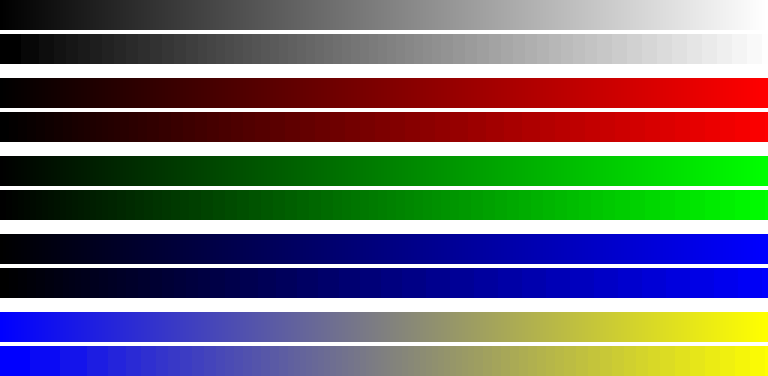
A step of 1 is meant to be just noticeable, so you may see the edges in the lower bars faintly; on some bars they are hard to see at all. A difference of 1 is a convention for “just noticeable,” and nobody measured it on your screen. The black-to-blue line has the fewest steps because full blue is dark: its CIELAB lightness is only about 32 out of 100, so the line covers less of the lightness scale than the others.
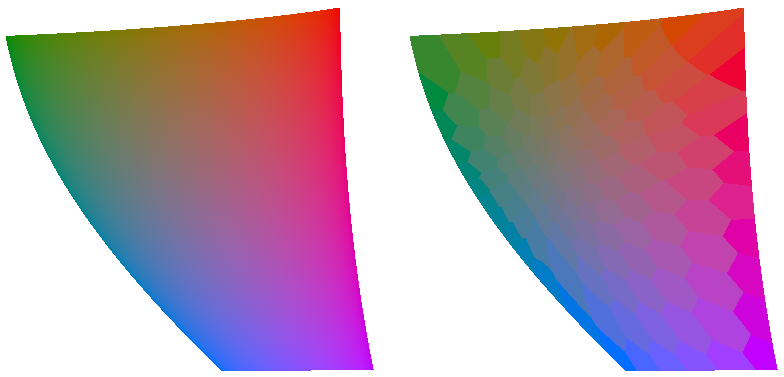
The same idea in two dimensions: a slice through the screen's colors at medium lightness (CIELAB L* = 50). The fan shape is the edge of what a screen can show at this lightness. On the left the slice is smooth; on the right every point takes the color of the nearest of a set of colors spaced 5 ΔE2000 apart, 5 times the just-noticeable step, so that the patches are big enough to see. With a step of 1 the same slice would hold 3,058 patches, far smaller than the ones shown here.
How the screen compares with the 2 million
On the CIELAB count, the screen's 858,618 cubes are about 38% of the 2.28 million Pointer and Attridge give for all surface colors. That share is only a rough guide: we could not read exactly how they counted, and we did not check color by color how far the two ranges overlap.
Even within one method the counts are not exact. Candry, De Visschere and Neyts report that the usual methods “underestimate the maximum number of mutually discernible colors” of a display. Our palettes show a quieter version of the same thing: the order in which you pick colors changed our count by 29%.
What our numbers can't tell you
- Only screen colors. We counted the sRGB range with a D65 white, the default for the web. Wide-gamut screens, printed colors, real surfaces and colored light all have other ranges.
- CIEDE2000 is a model. It was fitted to color-discrimination data for object colors, so a value of 1 is a convention for “just noticeable”; it was never measured as a threshold for every color. The formula also has small mathematical discontinuities.
- One white, one light level. Masaoka and colleagues counted over a range of color temperatures and illuminance levels and found that the estimates shift with them and with the model of how the eye adapts. Our count assumes one fixed screen white.
- Telling colors apart is a different task from naming them. Judd and Kelly's naming system, from the paper the ten million appears in, has 319 names.
Try it yourself
Put two colors into the Delta E calculator to see how far apart they are in CIEDE2000, CIE94 and CIELAB. To see all 16,777,216 screen colors at once, open every RGB color in one image; most neighbors in it are closer than 1 ΔE2000.
How we computed the numbers
sRGB codes are converted to CIELAB with the D65 white point, and differences use CIEDE2000 with all weights set to 1. Our implementation matches the culori library to within 4e-14 on 20,000 random pairs. The volume is the integral of the CIEDE2000 metric over the RGB cube on a 128-step grid (a 64-step grid gives 0.02% different). The palettes scan all 16,777,216 codes; after each run every pair of kept colors was checked again, and none was closer than the threshold. The script is scripts/guides/how-many-colors.mjs in our code; computed on 8 November 2026.