All RGB Colors in One Image
There are 16,777,216 RGB colors with 8 bits per channel (256 levels each for red, green and blue), and a 4096×4096 image has exactly that many pixels. Pick a layout, draw the image in your browser, count that every color appears exactly once and download it as a PNG.
Generate the image
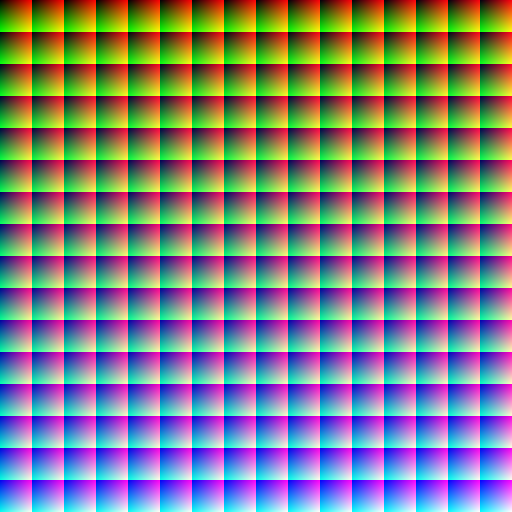
256 squares of 256×256, one per blue level. Red grows to the right, green downwards.
Drawn in your browser, nothing is uploaded. Tiles and Sorted by HEX take a few seconds. The Hilbert curve takes about 10 s in desktop Chrome and longer on a phone, and the page may pause while it draws.
The numbers
Each channel of an RGB color, red, green and blue, takes a value from 0 to 255. That gives 256 × 256 × 256 = 16,777,216 combinations, every HEX code from #000000 to #FFFFFF. A square image of 4096 × 4096 pixels has the same count, since 4096² = 256³ = 2²⁴, so it can hold each color once with nothing left over.
The colors make a cube, and a picture is flat, so none of the layouts here keeps every pair of similar colors side by side. Measured over all neighboring pixels, here is how often neighbors are one step apart:
| Layout | Neighbors one step apart | How it is built |
|---|---|---|
| Tiles | 99.6% | 256 squares of 256×256, one per blue level. Red grows to the right, green downwards. |
| Hilbert curve | 65.9% | A Hilbert curve is a path that visits every point and keeps nearby points together. The color cube is walked along a 3D one and laid on a 2D one: neighbors are close, with seams. |
| Sorted by HEX | 49.8% | #000000 top left, then every code in order, row by row, to #FFFFFF bottom right. |
ΔE2000 is a number for how different two colors look to people: about 1 is a common rule of thumb for the smallest difference noticed side by side. Between a color and its neighbor one step away in a single channel, like #804020 and #804021, the median ΔE2000 is 0.22 in a sample of 200,000 random pairs (sRGB, CIEDE2000), and 99.97% of them are under 1. The largest is about 1.2, in dark greys. So one step is almost always below what people notice, and banding you see mostly comes from where a layout puts its seams, not from the colors themselves.